
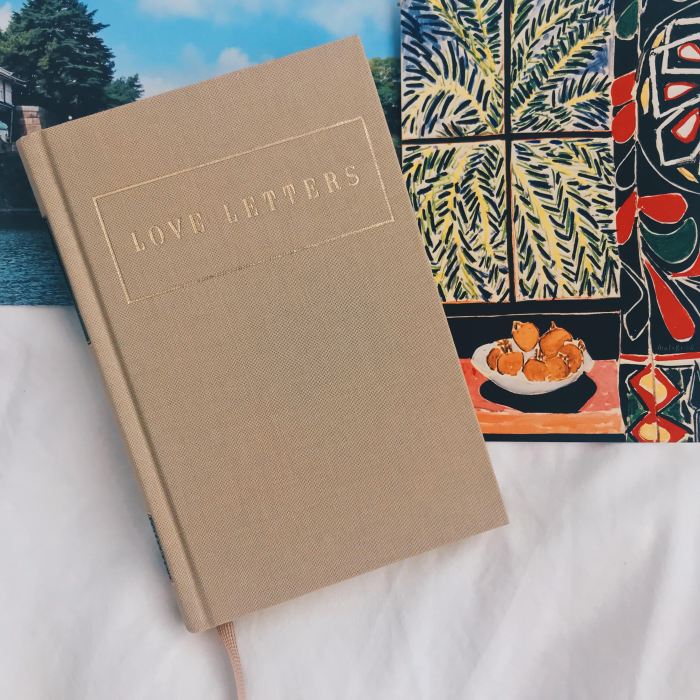
February 14th is always a day where we see a deluge of proclamations of love for significant others. And it got me thinking a lot about one particular medium: the love letter. So I read through an anthology of love letters by Everyman’s Library. It’s a panoramic flight through the hearts and minds of great women and men of history: Elizabeth Browning, Marcel Proust, Virginia Woolf, John Keats, and so many others.
Love might be ignited by circumstance, by shared values, or even magic. But love letters show that the practice of communicating love—and in general, the practice of maintaining love and care—is a continuous effort where the tangible and the spiritual must work in conjunction. I think that’s why I’ve been so enthralled with reading through all of these love letters: in our digital world where text messages are instantaneous and easy, the love letter as we understand it is an act of quiet effort that makes the intangible into the tangible in both linguistic and physical form.
That being said, I want to think about tangibility: is a handwritten letter the closest thing to a totem that represents the soul of the lover? Letter writing is an act of deliberation: one sits down, takes a pen in hand, and writes one’s most vulnerable thoughts in a handwriting style unique to oneself. They are a personalized immortalization of one’s thoughts for another. In fact, the idea of letters as totems of love is so deep-seated in our culture that when Gabrielle Chanel designed her now-famous black quilted bag in 1926, she included a small closable pocket on the inside to hold her love letters like little amulets—yeah, remember that space you put your gum and metro card and receipts in? It was actually designed for letters from the Duke of Westminster and Pierre Reverdy.
Of all the love letters was a letter from Napoleon Bonaparte to Josephine Beauharnais:
Sweet, incomparable Josephine, what a strange effect you have on my heart… My soul aches with sorrow, and there can be no rest for your lover… Ah! [it] was last night that I fully realized how false an image of you your portrait gives… Until then, mio dolce amor, a thousand kisses; but give me none in return, for they set my blood on fire.
This letter was written December 1795—they’d be married a month later, but in that moment, Napoleon was in the midst of the French revolutionary war as part of the republican Army of the West, fighting royalist forces led by the Count of Artois. But even in the chaos of war, Napoleon is consumed by his preoccupation to return to Josephine. His longing is palpable. In later years, Napoleon would send rose species from every region he conquered so that Josephine could have the largest collection of roses at her estate of Malmaison—isn’t it easy (and kind of funny) to imagine that each shipment of roses (and sometimes zebras) came accompanied with another hot and bothered letter from the legendary French general?
I realize that the elements that made love-letters of the pre-digital era so important are elements not of the medium itself, but of the human connection that are relevant (and maybe, even hungered for) in the Age of Instagram: kindness, consistency, communication, deliberation, and bearing one’s soul to another. It makes me think about one of my favorite poems. It is by the great Sufi Persian poet Hafiz:
It happens all the time in heaven,
And some dayIt will begin to happen
Again on earth –That men and women who are married,
And men and men who are
Lovers,And women and women
Who give each other
Light,Often get down on their knees
And while so tenderly
Holding their lovers hand,With tears in their eyes
Will sincerely speak, saying,My dear,
How can I be more loving to you;How can I be more kind?
So maybe it’s not just about the love letter. Maybe it’s about making an effort to be kinder, more present, more generous with your light. The medium might change, but the elements of what make strong human connections are transcendent. So I ask myself—in a world where visualizing love and care is easy, am I doing more than just visualizing? What am I doing to deliberately and thoughtfully act on my care for others?
 Taking Things Literary